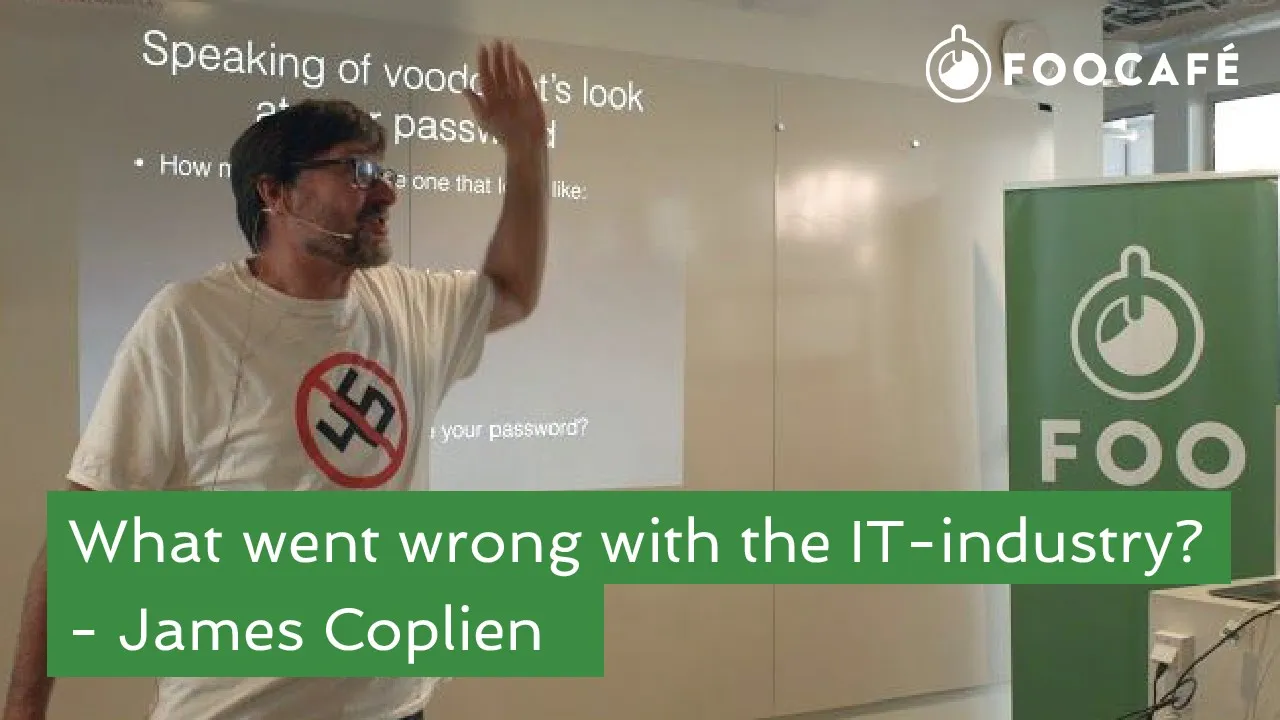
What went wrong with the IT-industry? - James Coplien
We like to point to software as the bad boy of professional disciplines — we build the wrong things, deliver late, and run up unbelievable costs. And we’ve been at this for 50 years. What’s wrong with us? Yet software delivers late half as much as construction projects do. For any project longer than 10 days software people are almost infinitely more accurate than the weatherman. We won’t talk about airline on-time departure performance. And, in terms of forecasting to within a week’s accuracy, pregnancy prediction is even worse. If development responds to continuous market feedback it is very difficult to deliver the wrong thing, and it’s hard to miss expectations about the timing. We do know how to do this right. And some groups are succeeding. We find excuses among those who fail, from whom the analyses are frequently of the nature, “They didn’t get the right requirements up front” as though requirements are a thing you gather up front. Or: “they didn’t deliver what was promised” as though one knows at the outset what one needs. The whole industry — both vendors and consumers — share a perspective that demonstrate a frustratingly high level of ignorance about how complex systems work. Are modern development approaches the solution? The success stories range from Toyota to Google. But saying that one uses a modern framework doesn’t help. There is a frightening gap between the ideals behind modern frameworks and the way they are interpreted in current broad practice, or by the standards for certification, or by the education systems that tool people for development. Those willing to make a quantum leap in learning can eradicate the problems, but it begs a radically new way of doing business and of managing development. Even the most agile companies have not come to grips with how much more old ways of thinking they must leave behind. The problems are no different than James "Cope" Coplien has extensive experience in this field he has been active as a developer, coach, tutor and mentor in many companies. He has written more than ten books on different subjects from C++ to Architecture and he is still involved in creating a new language to make things right. ___________________________ Foo Café is an independent and physical meeting place for people of all backgrounds and expertise within the IT-industry. Foo Café is aimed at those interested in sharing and learning. Born out of the desire to create a year round conference like atmosphere, Foo Café is THE place for planned and spontaneous meetings of all sizes and interests within the IT arena. Enjoy a coffee or a cold beer, along with light pub fare, and engage with other like minded individuals interested in sharing their knowledge and learning from one another. Foo Café is sourced by individuals, small, medium and goliath-sized enterprises, as well as entrepreneurs. Awaiting you, after stepping over the Foo Café threshold, is a space that is recruitment and product placement safe!
Chapters
- 0:00 Introduction
- 1:20 Emergency
- 3:03 Statistics
- 5:45 Computer Science
- 6:59 Passwords
- 11:49 Why do we believe
- 15:34 Unit tests
- 18:54 Tuchman cycle
- 21:40 The Dunningkruger effect
- 24:53 Illusion of explanatory depth
- 27:02 Agile software development
- 30:20 Agile projects
- 32:33 Domain knowledge
- 33:38 Scrum
- 41:07 Thinking Fast
- 42:45 Concrete Things
- Channel
- FooCafe
- Views
- 127